
GM Squarebody Truck Technical Specifications & Engineering Hub (1973–1987)
The definitive workshop repository for third-generation Chevrolet and GMC C/K series pickups, Suburbans, and K5 Blazers. Grounded in factory service manuals, engineering parts books, and SAE torque standards.
Model Year, Trim & Wheelbase Engineering Selector
Select any production year and chassis configuration to inspect factory wheelbase, frame dimensions, engine offerings, and styling revisions.
Crosshatch mesh pattern grille with round headlights. Oldsmobile 350 LF9 diesel engine optional. Introduction of iconic brushed stainless exterior side trim.
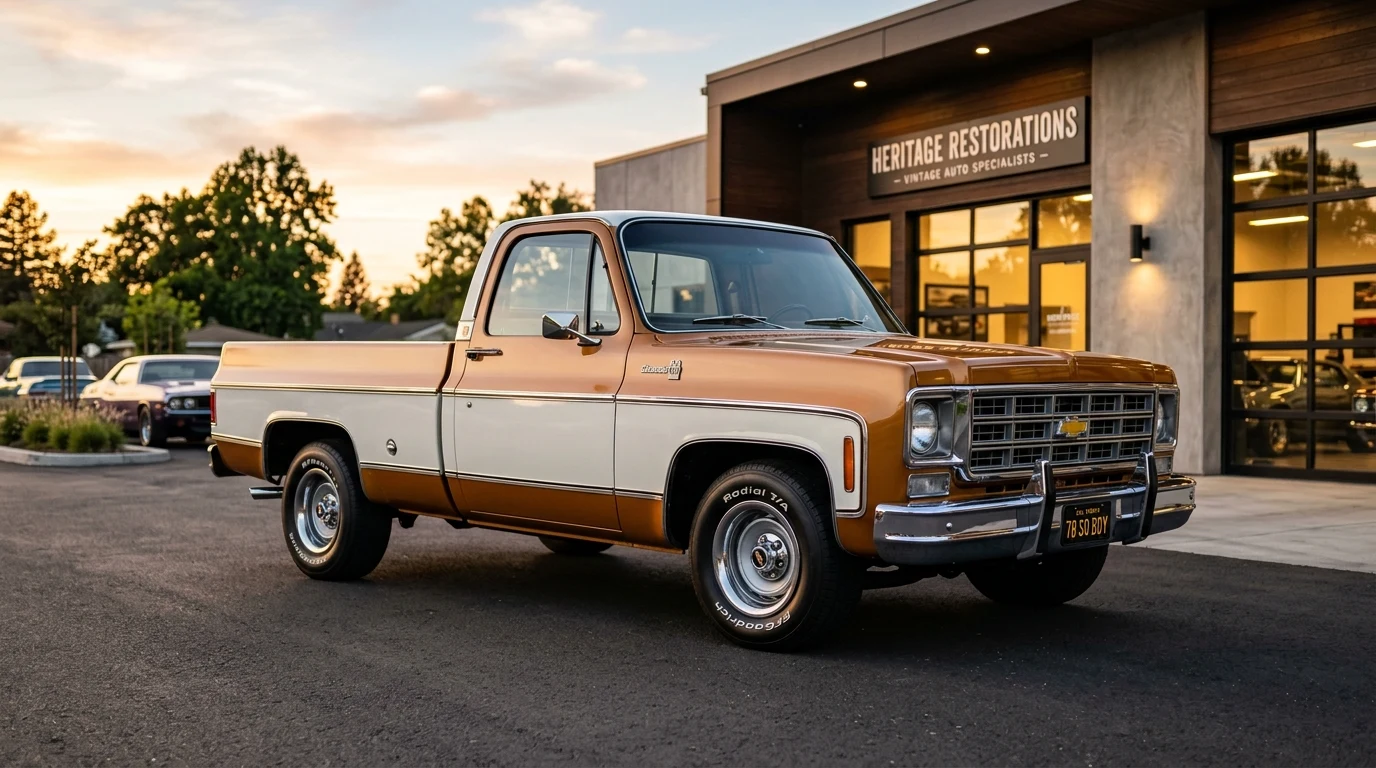
What is a GM Squarebody Truck and What Years Were They Built?
A GM Squarebody is a third-generation C/K-series Chevrolet or GMC pickup truck, Suburban, or full-size K5 Blazer produced between the 1973 and 1987 production years (extending through 1991 for R/V crew cabs and Suburbans). Known for its boxy, wind-tunnel-sculpted profile, the platform offered 1/2-ton (10/1500), 3/4-ton (20/2500), and 1-ton (30/3500) chassis across 117.5-inch short bed, 131.5-inch long bed, and 164.5-inch crew cab configurations.
First introduced by General Motors in late 1972 for the 1973 launch year, the "Rounded Line" generation represented a clean-sheet technological redesign over the preceding 1967–1972 Action Line platform. General Motors engineers employed computer-aided design and aircraft wind-tunnel aerodynamic modeling to sculpt the exterior cab, introducing curved side door glass, integrated drip gutters, and an increased glass greenhouse area that expanded outward driver visibility by over 20 percent.
Despite factory marketing branding the truck as the "Rounded Line," automotive enthusiasts, restorers, and master technicians colloquially dubbed the generation the Squarebody in homage to its upright vertical grille, prominent horizontal shoulder swage lines, and boxy utilitarian stance. The vehicle proved to be the longest-running and highest-volume pickup generation in Chevrolet history, remaining in production across 15 standard model years. Owners looking to verify original factory assembly plant data or engine codes can utilize our 1973–1987 GM VIN and SPID RPO decoder.
Factory Engine Options: Small Block, Big Block & Detroit Diesel Specs
General Motors equipped the 1973–1987 Squarebody platform with seven primary internal combustion powertrain families spanning reliable high-torque inline-six workhorses, legendary small-block V8s, big-block heavy trailering powerplants, and naturally aspirated mechanical diesels:
| Engine Displacement | Engine Family | Fuel System | Factory Horsepower | Torque (ft-lbs) | Production Span |
|---|---|---|---|---|---|
| 250ci (4.1L) | Inline-6 Cyl | Rochester 1-bbl | 100–105 HP | 175 ft-lbs | 1973–1984 |
| 292ci (4.8L) | Heavy-Duty I-6 | Rochester 1-bbl | 115–120 HP | 215 ft-lbs | 1973–1987 |
| 305ci (5.0L) | Small Block V8 | 2-bbl / 4-bbl | 130–160 HP | 240 ft-lbs | 1976–1987 |
| 350ci (5.7L) | Small Block V8 | Quadrajet 4-bbl | 160–175 HP | 260–275 ft-lbs | 1973–1986 |
| 400ci (6.6L) | Small Block V8 | Quadrajet 4-bbl | 175–185 HP | 290 ft-lbs | 1974–1980 |
| 454ci (7.4L) | Big Block V8 (BBC) | Quadrajet 4-bbl | 230–245 HP | 360–385 ft-lbs | 1973–1987 |
| 6.2L (379ci) | Detroit Diesel V8 | Stanadyne Injection | 135–148 HP | 240–246 ft-lbs | 1982–1987 |
In 1987, General Motors discontinued carburetors across light-duty half-ton and three-quarter-ton pickups, introducing Electronic Fuel Injection (Throttle Body Injection or TBI) with the Rochester Model 220 assembly. When planning drivetrain modifications or engine swaps, calculate your road cruising velocity and engine stress with our transmission specs and highway RPM simulator.
Differential & Axle Identification: 10-Bolt, 12-Bolt & 14-Bolt Ratios
Drivetrain longevity and towing capabilities depend heavily on differential architecture. General Motors factory assembly plants matched rear axle assemblies to payload class and gross vehicle weight ratings (GVWR):
GM 10-Bolt (8.5-inch Ring Gear)
Standard equipment on 1977–1987 C10, K10, K5 Blazer, and Suburban 1/2-ton chassis. Identifiable by an oval cover measuring 10.75" high by 10.25" wide with 28 or 30-spline c-clip axle shafts.
GM 12-Bolt (8.875-inch Ring Gear)
Standard on 1973–1976 C10 1/2-ton trucks and optional through 1981. Features an irregular 12-bolt inverted pear-shaped cover. Highly prized for high-torque drag racing and hot rod applications.
GM 14-Bolt Full Floater (10.5-inch)
The benchmark heavy-duty axle fitted to C20, K20, C30, and K30 chassis. Protruding wheel hubs with 8 lug nuts, external axle retention bolts, and removable pinion support. Virtually indestructible.
For vehicles equipped with factory option code G80, an Eaton Gov-Lok mechanical locking differential is fitted inside the carrier, providing automatic wheel lockup when wheel speed variance exceeds 100 RPM. When servicing chassis electrical connectors or rear brake light circuits, review our color-coded wiring diagrams and electrical pinouts.
Frequently Asked Questions About Chevy & GMC Squarebody Trucks
01What years are considered GM Squarebody trucks?
Official third-generation GM C/K Squarebody trucks were manufactured from the 1973 through 1987 production years for standard pickups. Full-size Chevrolet Suburbans, K5 Blazers, GMC Jimmys, and heavy-duty 4-door crew cabs retained this classic body tooling through the 1991 production run under the re-designated GM R/V series before the full platform transition to GMT400.
02What is the difference between a C10 and a K10?
The 'C' and 'K' designations indicate factory drivetrain architecture. In General Motors chassis coding, 'C' designates two-wheel drive (2WD) with independent front coil spring suspension, whereas 'K' designates four-wheel drive (4WD) featuring a solid front drive axle with semi-elliptic leaf springs and a divorced or married transfer case (NP203, NP205, or NP208).
03What wheelbases were offered on 1973–1987 Chevy trucks?
GM Squarebody pickups were engineered on two primary wheelbase dimensions: 117.5 inches for the 6.5-foot short bed (Fleetside and Stepside models) and 131.5 inches for the 8.0-foot long bed. Four-door 3+3 crew cabs utilized a 164.5-inch wheelbase, while the full-size K5 Blazer and Jimmy rode on a tight 106.5-inch utility wheelbase.
04How do you identify a 10-bolt vs 12-bolt vs 14-bolt rear axle?
Differential identification is determined by counting the differential cover ring bolts and measuring the ring gear diameter. Half-ton trucks typically feature the 10-bolt (8.5-inch ring gear with round oval cover) or pre-1982 12-bolt (8.875-inch ring gear with irregular 12-sided cover). Three-quarter and one-ton models utilize the heavy-duty GM 14-bolt in either semi-floating 9.5-inch or full-floating 10.5-inch configurations with protruding wheel hub flanges.
05Where is the factory VIN located on a Squarebody truck?
On 1973–1980 trucks, the 13-character VIN plate is stamped onto a metal plate riveted to the driver-side door latch pillar (A-pillar). On 1981–1987 trucks, the standardized 17-digit ISO VIN plate is mounted to the driver-side instrument panel top pad visible through the windshield base. A complementary Service Parts Identification (SPID) paper decal is affixed to the interior glove box door.
Topical Engineering & Calculation Architecture Roadmap
Multi-phase expansion pipeline modeling all statutory, thermodynamic, and mechanical dependencies.
Core Sizing & Foundational Architecture
Primary real-time simulators, dimensional blueprints, and electrical/spatial tolerances.
Advanced Electrical & Sub-System Synthesis
DC-DC charging curves, alternator heat dissipation matrices, and solar MPPT efficiency models.
Environmental & Thermal Dynamics
R-value condensation envelopes, psychrometric heating loads, and passive ventilation airflow models.
Plumbing, Fluid Mechanics & Greywater Loops
PEX piping friction loss calculations, 12V diaphragm pump pressure drops, and freeze-risk mitigation.
Chassis Weight Distribution & Axle Equilibrium
Center of gravity (CoG) 3D coordinate modeling, GVWR compliance, and suspension deflection ratios.