
Universal 1973–1987 GM Truck VIN & SPID RPO Code Decoder
Instantly decode your third-generation Chevrolet C10, K10, C20, K20, Suburban, or K5 Blazer. Decodes assembly plant, factory engine displacement, and cross-references original SPID option codes.
Universal 1973–1987 GM Truck VIN & SPID Decoder
Enter your 13-character (1973–1980) or 17-character (1981–1987) VIN to decode division, assembly plant, factory engine, and chassis series in real time.
SPID Glove Box Decal RPO Code Explorer
| RPO Code | Category | Factory Description | Engineering Notes |
|---|---|---|---|
G80 | Axle / Differential | Differential, Positraction / Gov-Lok Heavy Duty Limited Slip | Eaton Gov-Lok mechanical locking differential |
Z84 | Trim Package | Cheyenne Super / Silverado Luxury Equipment Package | Full woodgrain trim, dual horns, deluxe bench |
M40 | Transmission | Transmission, Turbo Hydra-Matic 350 Automatic | 3-speed light/medium duty automatic |
M49 | Transmission | Transmission, Turbo Hydra-Matic 400 Heavy Duty Automatic | 3-speed heavy duty automatic for 3/4 and 1-ton |
MD8 | Transmission | Transmission, 700R4 4-Speed Automatic Overdrive | Overdrive 4-speed introduced 1982 |
MM4 | Transmission | Transmission, 4-Speed Manual SM465 | Muncie granny low transmission |
L48 | Engine | Engine, 350ci 4-bbl V8 (5.7L) | Standard high-output 350 V8 |
LS9 | Engine | Engine, 350ci 4-bbl Heavy Duty Truck V8 | Heavy duty emissions 4-bolt main 350 |
LF3 | Engine | Engine, 305ci 4-bbl V8 (5.0L) | Economy small-block V8 |
LE9 | Engine | Engine, 305ci 4-bbl V8 with ESC (Electronic Spark Control) | Knock sensor equipped 305 small block |
LT9 | Engine | Engine, 350ci 4-bbl HD V8 (1981–1986) | Heavy duty series truck engine |
LF9 | Engine | Engine, 350ci Oldsmobile Diesel V8 | Early diesel offering 1978–1981 |
LH6 | Engine | Engine, 6.2L Detroit Diesel V8 (379ci) | Naturally aspirated mechanical injection diesel |
LF8 | Engine | Engine, 454ci Big Block V8 (7.4L) | High torque big block for C20/C30 |
V01 | Cooling | Radiator, Heavy Duty Extra Capacity | 4-core copper brass radiator core |
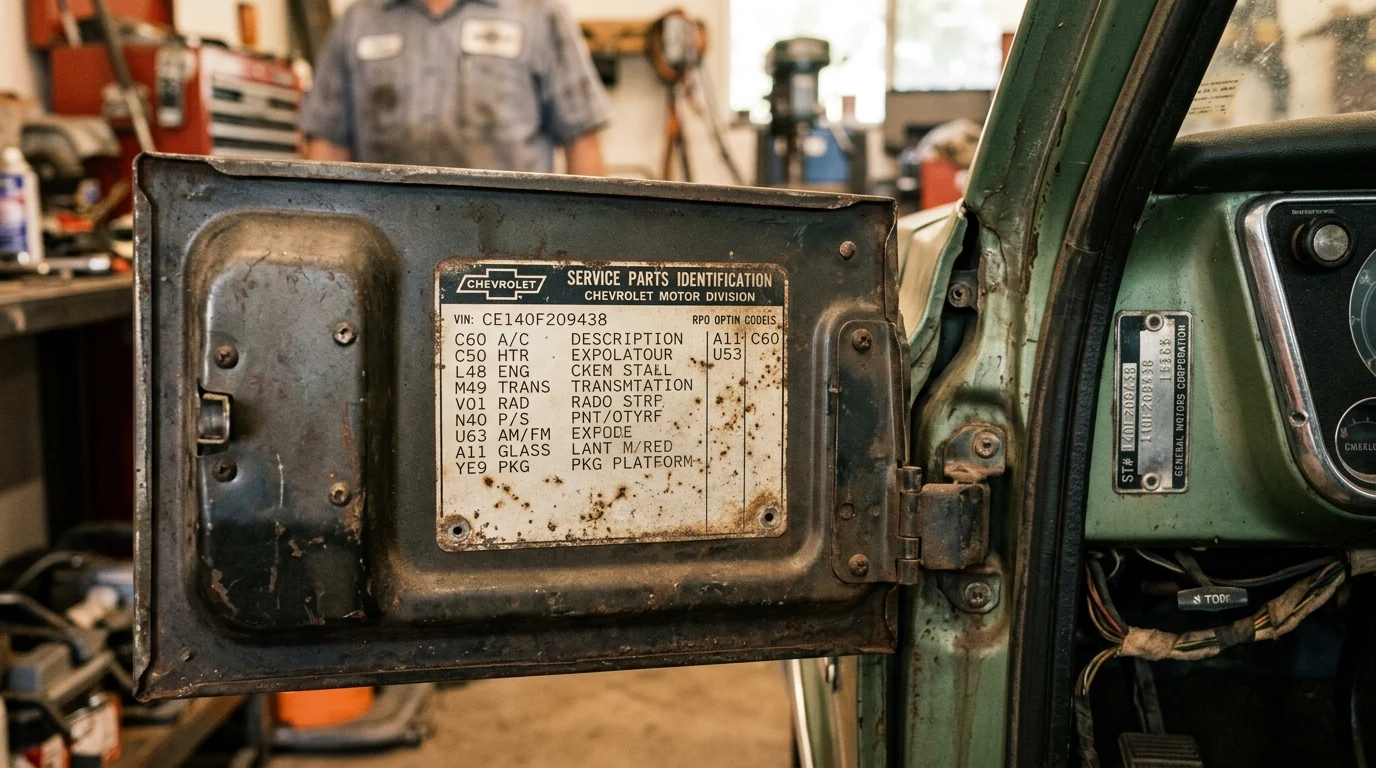
How Do You Decode a 1973–1987 Chevy or GMC Truck VIN?
To decode a 1973–1987 GM Squarebody VIN, identify whether your truck uses the 13-character system (1973–1980) or the 17-character ISO system (1981–1987). In the 13-digit format, position 1 denotes division (C=Chevy, T=GMC), position 2 designates 2WD (C) or 4WD (K), position 3 indicates engine displacement, position 4 marks GVWR series (1=1/2-ton, 2=3/4-ton, 3=1-ton), position 6 indicates model year, and position 7 reveals assembly plant.
Determining the authentic factory heritage of a classic GM truck requires understanding the structural partition between pre-1981 and post-1980 General Motors assembly protocols. For trucks produced between 1973 and 1980, GM employed a proprietary 13-digit alphanumeric structure stamped on a stainless-steel plate affixed to the driver's door latch pillar.
Beginning with the 1981 mid-cycle production refresh, General Motors aligned with Federal Motor Vehicle Safety Standard (FMVSS) 115, transitioning to the modern 17-character Vehicle Identification Number. This updated format relocated the physical VIN badge to the driver's side instrument pad, visible through the lower edge of the windshield glass. Restorers can verify their overall chassis dimensions against the GM Squarebody technical specifications hub.
Engine Code Breakdown & Assembly Plant Identification
The assembly plant code (position 7 on 13-digit VINs, position 11 on 17-digit VINs) identifies the physical facility that manufactured the chassis cab:
| Plant Code | Assembly Facility | Location | Notable Production Specialties |
|---|---|---|---|
| F | Flint Truck Assembly | Flint, Michigan | High-volume C10/K10 pickups and K5 Blazer bodies |
| J | Janesville Assembly | Janesville, Wisconsin | Heavy-duty C20/C30 commercial and fleet models |
| S | St. Louis Truck Assembly | St. Louis, Missouri | Dual-tank pickups and Suburban wagon chassis |
| 1 | Oshawa Truck Assembly | Oshawa, Ontario, Canada | Canadian-spec and export Squarebody platforms |
| Z | Fremont Assembly | Fremont, California | West Coast deliveries and early California emission trucks |
When cross-referencing your decoded engine displacement against drivetrain configurations, remember that axle gear ratios heavily dictate cruising engine speed. Verify highway engine RPM after changing wheel sizes or tire diameters with our transmission gear ratio and RPM calculator.
SPID Glove Box Decal RPO Code Lookup Table
While the VIN confirms the base chassis, engine displacement, and assembly plant, it does not reveal the vehicle's optional equipment. That responsibility falls upon the Service Parts Identification (SPID) decal affixed inside the glove box.
Regular Production Option (RPO) codes consist of 3-character alphanumeric designations representing everything from factory paint color break lines (e.g. ZY3 for special two-tone) to limited-slip differentials (G80) and air conditioning packages (C60). If your SPID sticker is missing or weathered from decades of use, our interactive table above provides the most complete registry of classic 1973–1987 GM truck option codes available online.
Frequently Asked Questions About Squarebody VIN Decoding
01Where is the VIN stamped on a 1973–1987 Chevy truck frame?
In addition to the door pillar or dashboard plate, General Motors stamped a confidential partial VIN directly onto the driver-side top frame rail flange. On two-wheel drive C10s, this stamping is typically located directly below the driver's floorboard or forward near the steering gear box. It consists of the division, model year, assembly plant letter, and the 6-digit production sequence number.
02How do you know if a Squarebody has its original engine?
To verify numbers-matching originality, check the engine pad stamping located on the front passenger-side cylinder block deck, just forward of the cylinder head. The pad contains an engine assembly code (date and suffix) and a partial VIN derivative. If the 6-digit derivative matches the final six digits of your truck's VIN plate, the engine is confirmed factory-original.
03What does the SPID glove box decal look like?
The Service Parts Identification (SPID) is a printed paper or foil decal affixed to the inside face of the glove box door. It lists the vehicle's full VIN, wheelbase, exterior paint code numbers, and three-column rows of 3-character Regular Production Option (RPO) codes describing every factory-installed feature from rear axle ratios (G80) to air conditioning (C60).
04Why did GM switch from 13-digit to 17-digit VINs in 1981?
In 1981, the National Highway Traffic Safety Administration (NHTSA) mandated a standardized 17-character ISO 3779 vehicle identification format across all automotive manufacturers sold in North America. This standard introduced international country codes, manufacturer identifiers, a mathematical check digit (position 9), and a standardized model year letter code.
Topical Engineering & Calculation Architecture Roadmap
Multi-phase expansion pipeline modeling all statutory, thermodynamic, and mechanical dependencies.
Core Sizing & Foundational Architecture
Primary real-time simulators, dimensional blueprints, and electrical/spatial tolerances.
Advanced Electrical & Sub-System Synthesis
DC-DC charging curves, alternator heat dissipation matrices, and solar MPPT efficiency models.
Environmental & Thermal Dynamics
R-value condensation envelopes, psychrometric heating loads, and passive ventilation airflow models.
Plumbing, Fluid Mechanics & Greywater Loops
PEX piping friction loss calculations, 12V diaphragm pump pressure drops, and freeze-risk mitigation.
Chassis Weight Distribution & Axle Equilibrium
Center of gravity (CoG) 3D coordinate modeling, GVWR compliance, and suspension deflection ratios.